 Carlos Ufano
Communication in Neighbourhood Communities Today
Communication in residents’ associations can be complicated, but today there are digital solutions that simplify everything. From mobile apps to online payment systems, these tools allow information to flow quickly, directly and in an organised manner. Here is a summary of how to improve communication in your residents’ association:
- Onzane: A platform that centralises all community management, from incidents to payments.
- Mobile apps: Instant notifications and direct communication between residents and administrators.
- Incident management: Report and track the progress of repairs from your mobile.
- Centralised documents: Digital access to minutes, regulations and budgets.
- Forums and groups: Online spaces to discuss, propose ideas and organise activities.
- Digital bookings: Systems to manage the use of communal facilities.
- Online payments: Simplify the payment of fees and reduce late payments.
- Surveys and polls: Gather residents’ opinions quickly and efficiently.
- Direct messaging: Instant communication tailored to specific needs.
- Personalised notifications: Relevant, real-time information for every resident.
These tools not only save time and resources, but also improve community relations by reducing misunderstandings. If your community still relies on physical noticeboards or face-to-face meetings, it’s time to make the leap to digitalisation. Discover how these solutions can transform your day-to-day life!
1. Onzane: Comprehensive community management platform
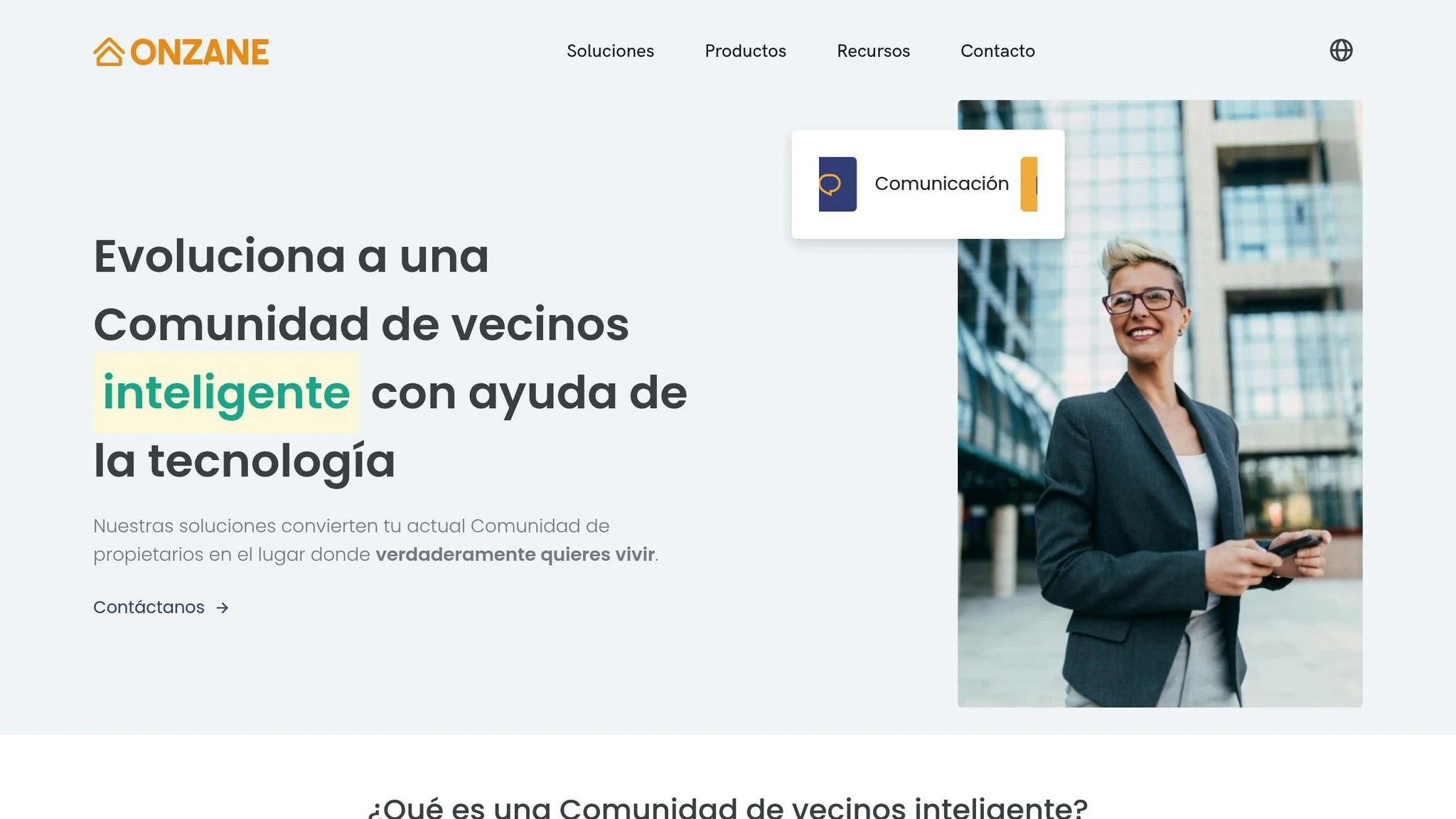
Onzane is a digital solution designed to improve communication in residential communities in Spain. Its aim is to centralise all the necessary tools so that residents, administrators and staff can interact efficiently and clearly.
Improved communication
With Onzane, all community members have access to a single communication channel available at any time. This eliminates the need for physical noticeboards or reliance on office hours, as updates reach users’ devices instantly.
Furthermore, the platform protects residents’ privacy, allowing them to communicate with one another without having to share personal data, which is particularly useful in communities where discretion is important.
Easy for residents to use
Onzane facilitates interaction with the Community Management through an asynchronous communication system with instant notifications. This allows residents and staff to manage community matters without relying on office hours, making management more transparent and efficient.
Tools designed for every community
The platform includes features such as unlimited storage for community documents, incident management, booking systems, online payments, access control, forums and personalised notifications. All of this is available on both the mobile app and the web version, offering practical solutions for every aspect of community life.
Affordable pricing for all communities
Onzane stands out not only for its features but also for its financial flexibility. It offers a free plan with basic tools and payment options starting from just €2 a month, tailored to the size and needs of each community.
Thanks to this flexibility, communities can tailor their use of the platform to their budget, ensuring efficient internal communication without compromising available resources.
2. Mobile apps for communication between residents
Mobile apps have transformed the way residents in housing communities communicate. Beyond the features offered by Onzane, these tools ensure smooth and personalised communication, leaving traditional methods such as noticeboards or face-to-face meetings behind.
Improvements in communication
Thanks to these apps, residents receive instant notifications on important matters, such as scheduled water cuts or changes to cleaning schedules. Furthermore, they can reply, ask questions or report issues directly from their devices. Everything is recorded in a searchable history, eliminating the need to remember details or search for misplaced documents. This makes information management much simpler and more accessible.
Easy to use for all residents
The intuitive design of these apps means any resident can use them without needing advanced technical knowledge. The registration process is quick and secure, as it includes proof of residence, and offers the option to customise notifications according to each user’s preferences. Furthermore, compatibility with Android and iOS devices ensures everyone can access the app, which is particularly important given the technological diversity in Spain.
Features designed for community life
These apps are designed to address the specific needs of communities. For example, digital voting systems facilitate decision-making without residents having to physically attend meetings. They also feature contact directories that protect privacy, allowing communication without sharing sensitive personal data. These tools not only improve connectivity between residents but also pave the way for tackling more complex issues, such as incident management, which will be discussed in the next section.
Costs tailored to each community
The implementation of these solutions is flexible and adapts to the size and needs of each community. Many applications offer scalable models, making them accessible both to communities on tight budgets and to those seeking more advanced features. This allows any neighbourhood to benefit from these tools without cost being a barrier.
3. Incident management systems for maintenance requests
Incident management systems have completely transformed how communities manage maintenance and repair requests. Now, the entire process, from the initial report to the resolution, is centralised in a single system, leaving behind traditional methods that often led to confusion. Here we outline their main advantages.
Improved communication
One of the biggest advantages is the ability to receive real-time updates via different channels. Residents can keep track of the status of their requests via email, SMS or an app, without needing to call the property manager for information.
Furthermore, these systems automate key processes. For example, if a water leak is reported, the system immediately forwards it to the maintenance team, whilst a less urgent request, such as changing a light bulb, follows a standard workflow. This ensures that issues are managed efficiently and without unnecessary delays.
Ease of use for residents
The design of these systems focuses on simplicity, allowing residents to use them without complications. Self-service portals not only make it easier to report issues but also offer knowledge bases to resolve frequently asked questions without needing to call the management.
Instant communication is another key strength. Whether via text messages, emails or mobile apps, residents can describe their issue and receive updates directly on their devices. The entire registration and categorisation process is intuitive, making it accessible to all residents.
Features tailored to the community environment
These systems include tools designed specifically for residential communities. For example, mobile accessibility allows residents to report incidents and communicate with the management team from anywhere and at any time, which is particularly useful when problems arise outside normal office hours.
Another key feature is the analytics and reporting functions. These tools help identify patterns in the types of incidents and response times, enabling the management team to improve their strategies and provide a more efficient service. Furthermore, this information is essential for anticipating recurring problems and planning preventive maintenance tasks.
Solutions for all budgets
Finally, these systems are flexible in terms of cost, making them accessible to communities of all sizes. From small buildings on tight budgets to large housing estates, everyone can benefit from more efficient maintenance management. Furthermore, these tools can be the first step towards implementing other digital solutions, such as centralised document storage, which further optimise community administration.
4. Centralised document storage for sharing information
Centralised document storage is transforming the way information is managed in communities. With this tool, all important documents are gathered in a single digital space, eliminating tedious manual searches and the risk of documents going missing. Residents can access minutes, regulations, budgets and notices at any time. Let’s see how this solution improves communication and simplifies document management.
How it improves communication
Having documents accessible digitally enhances transparency. Residents can check the status of accounts, review decisions made at previous meetings or access service contracts without needing to request copies from the administrator. This not only reduces repetitive enquiries but also fosters trust between the administration and residents.
Version control is another key advantage, as it allows a complete history of changes to documents to be maintained, avoiding confusion over which is the most recent version. Furthermore, automatic notifications alert residents whenever a new document is uploaded, keeping them constantly up to date and promoting smoother communication.
Ease of use and practical features
Modern systems are designed with user-friendly interfaces, meaning no advanced technical knowledge is required to operate them. Documents are organised into themed folders such as Administration, Maintenance, Meetings or Regulations, making it easy to find what you’re looking for. Furthermore, the advanced search function allows you to quickly locate specific documents by entering keywords, dates or file types, saving time and effort.
Role-based access adds an extra layer of customisation and security. For example, landlords can view detailed financial information, whilst tenants have access only to regulations and general notices. Furthermore, controlled downloads allow users to obtain copies for personal use, whilst the system logs access to comply with legal regulations.
Automatic synchronisation with mobile devices ensures that documents are available on computers, phones and tablets alike. This is particularly useful during meetings or when you need to check information whilst away from home.
Cost-effective solutions for all communities
This type of storage not only improves management but is also affordable for communities of any size. Scalable options allow you to choose from basic packages for essential needs to advanced platforms with multiple functions. Furthermore, the savings in administrative time and the reduction in telephone enquiries quickly offset the initial investment.
Integration with other digital systems within the community, such as incident management tools or communication apps, creates a comprehensive digital ecosystem. This not only improves efficiency but also tailors the solution to the specific needs of each community, aligning with the trend towards digitalisation in day-to-day management.
5. Online forums and residents’ groups
Online forums and residents’ groups have transformed the way communities communicate, providing digital spaces where residents can interact, share ideas and resolve queries collectively. These platforms act as virtual meeting points that encourage active participation and strengthen relationships between community members. Furthermore, they complement other management tools to create a more comprehensive and efficient communication system.
How they improve communication
Digital forums allow conversations to flow without time restrictions. This means that residents can ask questions about regulations, recommend local services or discuss community proposals at any time of the day. This level of flexibility overcomes the limitations of traditional communication methods.
Moderation is key to maintaining a constructive atmosphere. Administrators can organise discussions into categories such as ‘Maintenance’, ‘Security’, ‘Social Events’ or ‘Suggestions’. This not only makes it easier to find specific information but also keeps conversations on track. Furthermore, tools such as tags and search functions streamline access to recurring topics.
Another advantage of forums is that they promote transparency and democratic participation. Residents can discuss proposals before face-to-face meetings, making these gatherings more productive and ensuring decisions are better informed. This increases residents’ engagement with neighbourhood initiatives.
Easy to use for all residents
Ease of use is one of the strengths of these platforms. With intuitive interfaces, community forums do not require advanced technical knowledge. Residents simply need to register with their email address to start participating. Posting messages, replying to comments or sharing images is as straightforward as on any social media platform.
Customisable notifications are another key benefit. Each user can decide what type of alerts to receive and how often, from immediate notifications on urgent matters to weekly summaries. This prevents information overload and keeps residents engaged.
What’s more, the forums are accessible from any device: computers, tablets or mobile phones. This allows residents to participate at any time, whether by replying quickly during a break or posting more detailed messages from home.
Practical features for the community
Modern forums not only facilitate communication, they also include tools designed for the specific needs of communities. For example, voting features allow collective decisions to be made quickly. Residents can vote on proposals, activity schedules or the selection of suppliers directly from the platform, removing barriers of time or location.
Another key feature is the management of community events. Forums allow residents to propose activities, coordinate celebrations or even organise group purchases. Furthermore, attendance confirmations and logistics are easily managed from the same platform.
The ability to share multimedia files also enriches conversations. Photos of issues, project plans or images from past events help convey ideas more clearly and avoid misunderstandings that might arise in text-only communications. Integrating the forums with other digital systems within the community further strengthens overall management.
Affordable options for all communities
Community forums typically offer basic plans that include essential features such as organised discussions, moderation and notifications. More advanced plans add tools such as polls, event management and integrations with other systems.
The savings and efficiency are evident from the outset. They reduce telephone enquiries to the administrator, minimise the need for face-to-face meetings and streamline decision-making. Furthermore, by integrating with existing platforms, such as document management systems or maintenance tools, forums maximise return on investment, significantly improving organisation and community communication.
6. Digital tools for booking events and facilities
Digital tools have completely transformed the way community spaces are managed. Now, booking facilities such as function rooms, swimming pools, sports courts or barbecue areas is much simpler and more efficient. These platforms allow residents to check timetables, make bookings or cancel them at any time and from any device. Furthermore, by automating processes, the administrative burden is reduced, which improves the experience for both users and community managers. All of this contributes to more streamlined management and more effective internal communication.
How they improve communication
Digital booking systems function as genuine shared information hubs, where all residents have access to up-to-date availability of facilities in real time. This eliminates confusion and ensures everyone is aware of existing bookings.
Furthermore, these tools send automatic reminders and notify users of any changes or cancellations, keeping residents informed without the need for manual intervention. As if that weren’t enough, they also improve coordination among residents. For example, if someone cancels a popular booking, the system can automatically notify those on the waiting list, thereby maximising the use of spaces and avoiding misunderstandings.
Designed to be user-friendly
Accessibility is key to the success of these platforms. Residents can manage their bookings via intuitive mobile apps or simple web portals. Making a booking usually takes just a few steps: choose the space, select the date and time, and confirm.
Furthermore, these platforms usually include customisable notifications and the option to sync bookings with calendars such as Google, Outlook or Apple, allowing users to easily manage their commitments.
Features that meet community needs
Digital booking systems not only allow for the management of physical spaces, but also other community resources. For example, it is possible to book projectors, sound systems, extra tables or sports equipment. This ensures that available resources are used efficiently and are not left unused or poorly managed.
Another very useful feature is the option for recurring bookings, ideal for regular activities such as yoga classes, book club meetings or sports training sessions. Organisers can set up these bookings automatically, whilst the system takes care of sending confirmations and reminders.
Furthermore, many platforms include an integrated deposit and payment management system, which facilitates the collection and refund of event deposits. This ensures more organised management and reduces potential conflicts.
Affordable prices for all communities
These tools are often part of comprehensive community management platforms, such as Onzane, which includes booking systems from its free plan at €0 per month. This is much more cost-effective than hiring separate services, as residents can enjoy booking features alongside other management and communication tools.
Savings in administrative time are another key benefit. Communities that previously spent hours each week managing telephone bookings can now allocate those resources to other improvements. Furthermore, better utilisation of facilities can generate extra income if it is decided to rent out spaces to external parties during periods of low demand.
Finally, these solutions are scalable, meaning a small community can start with basic functions and gradually add more advanced features as their needs grow, without changing platforms or losing historical data. This flexibility makes them an ideal choice for communities of any size.
Try Onzane’s technology for free
You can create a one-month trial account for your community, property management firm or service provider.
It will only take two minutes.
7. Online payment systems for fees and utilities
Digital payment systems have transformed the way finances are managed in homeowners’ associations. There’s no longer any need to queue for ages at the bank or deal with cheques. Now, residents can pay their community fees, extraordinary expenses and utility bills from any device at any time. What’s more, automation not only streamlines cash flow but also helps reduce late payments, facilitating more efficient communication between managers and residents by reducing conflicts and queries related to payments.
How they improve communication
These systems function as an accessible and transparent financial information hub. Each resident can view their payment history, outstanding bills and the status of their fees in real time. This eliminates misunderstandings and reduces the need for frequent enquiries to the administration. They also send automatic reminders and payment confirmations, ensuring full traceability of every transaction. Both residents and administrators have access to a unified record that allows discrepancies to be resolved quickly and easily. Furthermore, the platforms are designed with user-friendly interfaces, tailored for all user profiles.
Easy adoption by residents
The key to these systems being well received by residents is their simplicity. The platforms offer intuitive interfaces that allow payments to be made in just a few clicks, without the need for advanced technical knowledge. Users can choose from various payment methods, such as debit and credit cards, bank transfers or direct debits. They can also set up recurring payments for their monthly fees, avoiding oversights or delays. For those less familiar with technology, the platforms include clear and easy-to-follow tutorials.
Features designed for communities
These systems go beyond simply paying fees. They include tools for managing extraordinary expenses, such as integrated voting where residents can review detailed budgets and vote on proposals before charges are made. They also allow for the payment of additional services, such as the use of guest parking spaces, special facilities, or even fines for breaches of the internal regulations. A particularly useful feature is the automatic issuance of certificates confirming that payments are up to date, which is essential for those wishing to sell or rent out their property. Furthermore, administrators can generate detailed financial reports that help them analyse the community’s financial situation, identify patterns of late payment and make informed decisions.
Affordable prices for all communities
Integrated with Onzane’s other tools, this online payment system offers a comprehensive solution for the financial management of housing communities. Onzane includes this functionality from its free plan at €0/month, representing significant savings in time and administrative costs. Processes such as payment reconciliation, managing late payments and issuing certificates, which previously required hours of work, are now automated. Furthermore, the platform is scalable, meaning that both small communities of 10 homes and large residential complexes can benefit from the same advanced tools, with no extra costs based on transaction volume. This improves the financial situation of communities and simplifies their day-to-day management.
8. Surveys and votes to gather residents’ opinions
Digital surveys and polls offer a practical and flexible way to gather residents’ opinions, adapting to the needs of each community. These tools are ideal for addressing issues such as improvements to communal areas or changes to regulations. Let’s explore how they facilitate the exchange of information within the community.
More direct and participatory communication
Thanks to their customisable design, these surveys enable smoother communication between administrators and residents. By tailoring the format and response options to each situation, they foster more direct dialogue and encourage the active participation of all residents.
Simplicity and tailored options
The intuitive interface of these tools ensures that any resident, regardless of their technical expertise, can participate easily. Furthermore, the ability to customise both the questions and the response options allows for surveys tailored to the community’s specific needs, ensuring that every opinion counts.
Affordability for all communities
The survey and voting system, integrated into the Onzane ecosystem, is available from the free plan (€0/month). This removes financial barriers and makes it easy for any community to implement participatory processes without worrying about costs. This solution not only modernises community management but also opens the door to future improvements in neighbourhood communication.
9. Direct messaging and contact lists
Direct messaging and organised contact lists are changing the way communities communicate, offering instant and personalised channels between residents, administrators and service providers. These digital tools not only streamline urgent communications but also improve day-to-day interaction within communities.
How it improves communication
Direct messaging systems break down traditional barriers by enabling immediate access for all parties. An interesting fact: 99% of messages are read within 3 minutes. This means that responses to urgent issues, such as breakdowns, security incidents or important announcements, are almost immediate, improving the efficiency of incident management.
Furthermore, organised contact lists allow communication to be segmented according to specific roles. For example, groups can be created for residents on a particular floor, board members, maintenance providers or emergency services. This segmentation ensures that every message reaches the right people and prevents information overload from irrelevant content.
Easy adoption for all residents
Ease of use is key to ensuring these tools are adopted by all residents. Currently, over 45% of people aged 65 and over use social media, demonstrating that technology is no longer an insurmountable barrier. Furthermore, voice messaging features are a great help for those who find typing difficult, whether due to conditions such as arthritis or a lack of experience with a keyboard. These features ensure that all residents, regardless of their level of tech-savviness, can actively participate in community communication.
Features designed for communities
In addition to direct messaging, these tools offer features tailored to the community environment. For example, the ability to create themed groups facilitates discussions on specific topics such as maintenance, social events, safety or community improvements.
Another advantage is the sharing of multimedia content, which allows users to share photos, documents or videos related to incidents or projects. Even automated calls are a useful option for those who prefer not to use text messages or emails. These tools, integrated into platforms such as Onzane, ensure that no one is left out of important communications.
Affordability
Onzane offers these communication tools as part of its free plan (€0/month), removing any financial barrier to implementation. This model allows communities of any size, from small housing estates to large residential complexes, to access professional solutions without straining their budget.
Furthermore, the system is scalable, meaning it can be tailored to the specific needs of each community. Whether it is a small housing estate with few residents or a large complex, cost will never be an obstacle to improving communication and administrative management within the community.
10. Personalised notifications and alerts for residents
Personalised notifications have revolutionised the way communities communicate, ensuring that every resident receives relevant information at the right time. From maintenance notices to emergency alerts, this tool significantly improves community communication.
More efficient communication
Thanks to segmentation, these notifications eliminate unnecessary information and are tailored to each resident’s specific circumstances, such as their location, type of property or services they have contracted. For example, those living on the ground floor may receive alerts about gardening work, whilst penthouse residents are notified about lift maintenance.
Furthermore, immediacy is key. Emergency alerts, such as water cuts or security incidents, are sent instantly to those affected, whilst routine communications, such as reminders or general notices, are scheduled at appropriate times so as not to disturb residents’ rest.
Easy to use for everyone
The system is designed to be accessible, allowing each resident to choose their preferred communication channel: push notifications, emails, SMS or even automated calls. All this, without any technical complications.
A particularly handy feature is the ability to set up family profiles. This allows different members of the household to receive the information most relevant to them. For example, parents can receive notifications about children’s activities, whilst maintenance alerts are directed to the person in charge of the household.
In addition, the system includes automatic reminders for important unread notifications, ensuring that essential information does not go unnoticed, but without being intrusive.
Features designed for the community
The system also offers specific features to meet community needs. For example, it includes automatic reminders for votes or important confirmations, as well as geolocation-based alerts to report nearby incidents, enabling a faster and more effective response.
Another key feature is the notification history. This log allows residents to easily view previous communications organised by category and date, which is useful for reviewing details on maintenance work, changes to regulations or information about community services.
No additional cost to communities
As part of the Onzane ecosystem, this advanced system is available at no cost (€0/month). This means that communities of any size can access a professional and scalable solution without the need for additional investment, ensuring efficient and modern communication for all residents.
Comparison table of communication methods
The way we communicate has changed dramatically in recent years. The Covid-19 pandemic accelerated the digitalisation of our societies, altering both communication habits and the consumption of information. This process has highlighted a clear difference between traditional methods and digital solutions. Here is a table comparing both approaches:
| Aspect | Traditional Methods | Digital Solutions |
|---|---|---|
| Response time | Slow: requires printing and manual distribution, and does not allow for immediate feedback. | Immediate: information is published and reaches the recipient instantly, allowing for two-way communication. |
| Accessibility | Limited to specific locations where printed materials or physical noticeboards are distributed. | High: available from anywhere with an internet connection and on multiple devices. |
| Scalability | Low: each update involves repeating the physical process of production and distribution. | High: a single action allows information to be shared with a wide audience simultaneously. |
| Operating cost | High: includes printing, paper, manual distribution and staff time. | Low: eliminates printing and physical distribution costs. |
| Tracking | It is not possible to know who has read the information or when. | Comprehensive: provides read statistics, read receipts and engagement analysis. |
| Updating | Requires physically replacing all content. | Instant: allows real-time modifications at no extra cost. |
The shift to digital
The advent of the internet has transformed traditional methods of communication, leading to a faster and more direct exchange of information. This shift not only speeds up processes but also improves the quality and reach of communication.
Practical benefits of digital solutions
As shown in the table, digital solutions offer clear advantages for optimising community communication. These tools not only speed up the delivery of information but also provide additional benefits.
For example, platforms such as Onzane enable immediate two-way communication, minimising the time between sending a message and receiving a reply. Whilst a physical noticeboard can take days to update and does not guarantee that all residents will see it, digital notifications reach registered devices instantly.
Furthermore, the versatility of these platforms allows access to information from any device, something that physical methods cannot offer. They also make it easy to consult past information at no extra cost, thanks to the digital archive.
Finally, this change not only improves efficiency but also reduces the environmental impact. By eliminating the use of paper and the need for physical travel to distribute information, these solutions align with current sustainability trends, which are increasingly valued by communities.
Conclusion
Effective communication within residential communities is key. As we have seen, today’s digital tools offer practical solutions that are changing the way residents and managers interact.
Unlike physical noticeboards, digital methods allow for immediate communication that is easy to track. Platforms such as Onzane not only reduce operational costs but also free up staff time to focus on more important tasks. Furthermore, they offer access to historical information at no extra cost and allow for detailed tracking of engagement, something traditional methods cannot match.
It is important to assess the specific needs of each community. Does information reach residents on time? Are there clear channels for reporting issues? Does the management of payments and bookings cause inconvenience? If any of these areas present problems, a comprehensive digital solution may be the answer. And beyond the operational benefits, we cannot ignore the impact on the environment.
Sustainability is also a key factor. Reducing paper use and avoiding unnecessary travel to distribute information not only helps the planet but also aligns the community with responsible, modern practices.
Digitisation is not just a technical issue; it is a commitment to improving the quality of life for all members of the community. This change not only optimises processes but also strengthens the connection between residents through more fluid, transparent and efficient communication. Take the step towards digitisation and transform your community today.
FAQs
What advantages do digital tools such as Onzane offer for managing communities compared to traditional methods?
Digital tools such as Onzane offer clear advantages for managing communities, surpassing traditional methods in many respects. These platforms simplify administrative tasks, such as sending notifications or managing incidents, saving time and effort for both administrators and residents.
They also transform communication by bringing all information together in one place, accessible in real time from any device. This not only improves transparency but also minimises misunderstandings and encourages greater resident participation in community life. In an increasingly connected world, these solutions have become key tools for meeting the current needs of communities in Spain.
How can communities protect residents’ privacy when using digital platforms for communication?
Communities can safeguard residents’ privacy by complying with the General Data Protection Regulation (GDPR) and using digital tools with advanced encryption. This helps protect sensitive information from potential risks.
It is equally important to carry out regular security audits and establish strict access controls. These measures reduce the likelihood of unauthorised access and ensure more secure data handling.
Another key recommendation is to use platforms with clear and easy-to-understand privacy policies. These platforms should offer options for residents to manage their preferences and ensure that their digital rights are always protected.
How can a community that uses traditional methods begin to integrate digital solutions to improve communication and management?
First and foremost, the community must analyse its specific needs and the technological resources at its disposal. This will enable it to set concrete goals and choose the most suitable digital tools, such as mobile apps for neighbour management or platforms that facilitate communication through community notices.
It is equally important to provide basic training to both residents and managers, ensuring that everyone can use these tools without difficulty. Furthermore, local aspects in Spain must be taken into account, such as the date format (dd/mm/yyyy), the use of the euro (€) and metric units, so that the experience is practical and accessible to all users.
 01
01
 02
02
 03
03